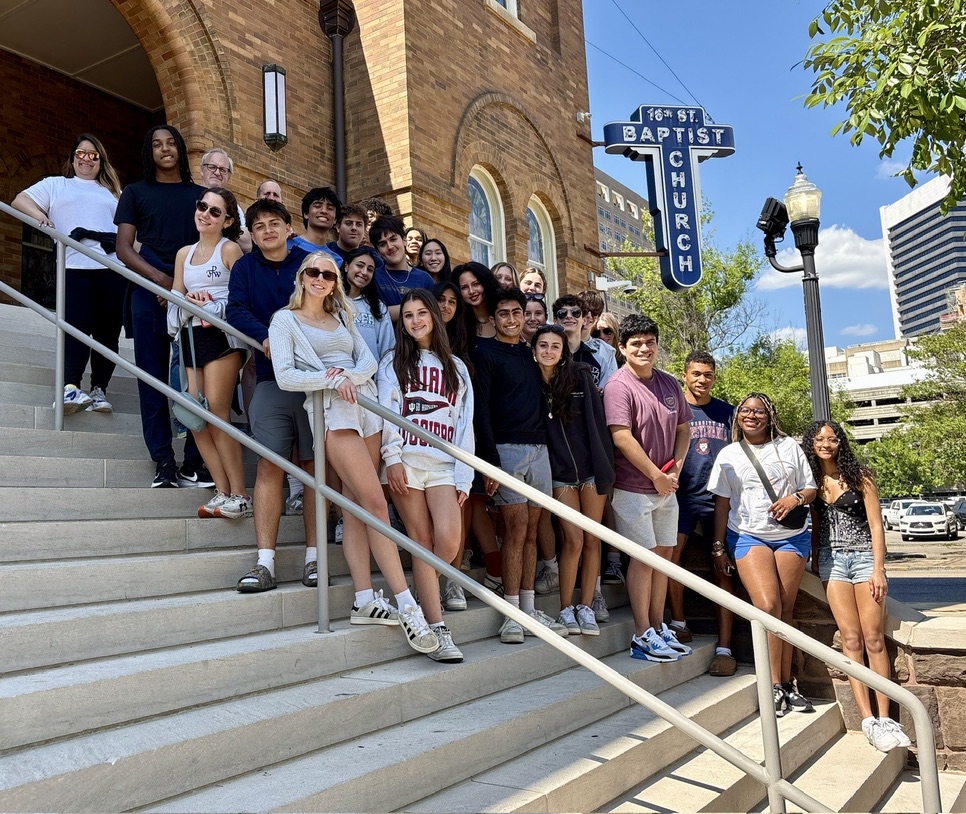
From May 13 to May 16, Parker seniors traveled to Alabama for the sixteenth civil rights trip.
26 seniors, including some of whom are in the Civil Rights Movement course, went to Birmingham, Selma, and Montgomery, Alabama. The course is taught by Upper School history teacher Andrew Bigelow. Along with Bigelow, Upper School English teacher Mike Mahany and College Counseling Coordinator Alexis Pantoja chaperoned the trip. Dr. Martha V. Bouyer led the trip.
Upon arrival in Birmingham, the group visited Dynamite Hill, Sixteenth St. Baptist Church, Kelly Ingram Park, and The Historic Bethel Baptist Church. “We’re using Alabama as our classroom,” Bigelow said. Later in the day, students had the opportunity to meet author Barbara Shores and Carolyn McKinstry, a survivor of the Sixteenth St. Baptist Church bombing.
The second day began with a 7:45 a.m. departure from Birmingham to Selma. “I was most eager to see Selma,” senior Owen Powell said. “Even though I’m not in the Civil Rights class, I’ve always been interested in that history, and it’s important to know.” The itinerary included a driving tour of Selma, touring Wallace State Community College, Edmund Pettus Bridge, and the historic route Highway 80 to Montgomery. “It’s so amazing that a bunch of students from all colors and backgrounds get to walk across the bridge where so much history took place,” senior Niara de Wit said. The rest of the afternoon was spent at a visit to Lowndes County Interpretive Center and a viewing of the 1994 documentary “A Time for Justice.” The group then went to the Equal Justice Initiative,EJI, National Memorial for Peace and Justice. Senior Coco De Leon looked forward to seeing the memorial. “I’ve read ‘Just Mercy,’ like most Parker students have, and I’ve learned a lot about Bryon Stevenson’s impact on civil rights,” De Leon said. Before checking into their hotel in Montgomery, students reflected at the Alabama State Capitol.
The third and final full day in Montgomery took students to the Rosa Parks Museum, Judge Frank M. Johnson Courthouse, the Civil Rights Memorial at the Southern Poverty Law Center, the Commerce Building, and Dr. Richard Harris House. “It’s really powerful looking at the history of systemic racism in our prison system,” Bigelow said. In the evening, the group went to the EJI Statuary Park boat ride, and reflected at Statuary Park.
“We can use this history to help us make our own history and speak out against things that are going on in the world,” de Wit said, “I think people see civil rights as a black people or minority issue. But it’s not. It’s an everybody issue.”
Before their flight took off at 5:04 p.m., the final activity of the civil rights trip was to visit the EJI Legacy Museum. As they picked up boxed lunches at Chappy’s Delly, students reflected upon the themes from the Civil Rights Movement course. “A lot of Chicago’s history is rooted in the south because so many folks migrated north as a result of terrorism. Hopefully they saw the roots of Chicago,” Bigelow said.