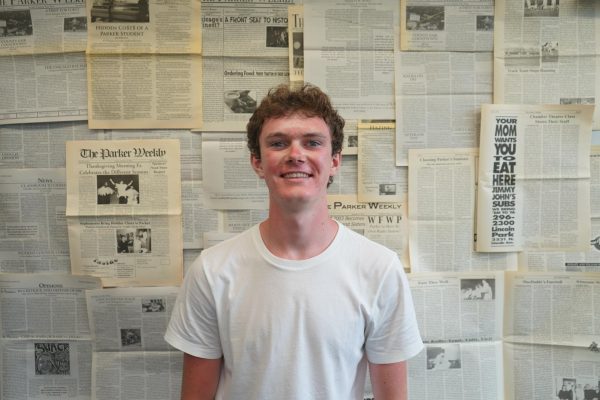
Student Government Elections for the 2026-2027 school year were held on Tuesday, May 5, closing out weeks of speeches, debates, and the installation of new wallpaper on the third floor in the form of election posters. Among the large crop of winning slates, seven students were elected to lead Student Government’s Cabinet next fall. Composed of the President, the Director of Committee Affairs (DCA), the Treasurer, and the student Senate heads, Cabinet is responsible for a majority of the decision-making within Student Government outside of the 45 minutes of plenary the student body experiences twice a cycle.
Following a historic, crowded six-candidate race that left many feeling politically strained, Trisen Phillips, Jr. became Student Government’s next president for the 2026-2027 school year. Phillips ran on a platform promising to refocus and recenter committees, define more clearly Student Government’s purpose, and declare a “galvanizing” War on Hate in the Upper School–one of the more radical ideas from all six presidential candidates’ platforms.

Student experience and involvement seem to be at the forefront of Phillips’ initiatives for next year, from his ideas found in his platform to his rhetoric when addressing the student body during recent speeches. “People are constantly wanting change and things that benefit them in terms of a school,” Phillips said, “and so we have a say in governing the way our school institution works surrounding us because this school is for us, not for the teachers.”
One of these primary initiatives is to open the school gym outside of PE class times for student use. “Not everyone can afford a Lakeshore membership or a Planet Fitness membership or anything like that,” Phillips said. “We have the facilities, so why not use them?” Another initial directive Phillips plans for next year is increased community building within Student Government-sanctioned time slots as it stays true to the school’s mission–something he spoke about frequently while campaigning. “I think about the people who aren’t involved in sports,” Phillips said. “How are they getting to know people within our community?”
The War on Hate, one of Phillips’ primary goals for next year, has received both supporters praising its frank originality and critics calling it idealistic. Either way, the idea had students talking all throughout election season. “I’m trying to allow people to know that our experiences should be validated,” Phillips said. Phillip’s first step in exacting this change is to acknowledge differing student experiences and hold space for a strong conversation about these differences. “I don’t think we need to have it focused on a student of color experience versus [the experience of] a white student ,” Phillips said. “I don’t think that’s the mission, I don’t think that’s the goal of what I’m trying to do.”
Since his win, Phillips has already seen a shift in the culture he’s been trying to change since freshman year. His ideal of unconditional love to combat hate, he says, is growing in the weeks following the announcement. “I’m a strong believer in God, and I just really thanked Him for allowing me to have this platform,” Phillips said. “I believe that I’m doing His work as being like a student here, but also being president.”

After a tight race with competitor and fellow junior Jade Labkon, junior Sam Goldblatt was elected Director of Committee Affairs. Both Labkon and Goldblatt had significant experience in Student Government, but longevity of the committee system, Goldblatt says, ultimately won him the race. “I want to promise and ensure a lot of change in the future,” Goldblatt said. “I think that a lot of people have that sentiment about committees.”
Goldblatt ran on a platform promising to ensure committee engagement among members, refine committee’s purposes, and improve the grading system. Next fall, he hopes to hit the ground running with more advanced planning for each committee which he thinks will help better utilize committee membership and fully realize big initiatives brought earlier in the year. “The biggest issue (facing committees) is a lack of direction and purpose,” Goldblatt said. “A lot of committees are willing to do a lot of great work, but they’re not really sure how they can get it done in the time that they have.”
One of Goldblatt’s biggest goals for the year is to bring each committee to a point of pride in the work that they do. This, he says, coupled with increased collaboration among committee members, will create change in the school next year. “I’m really excited to see what work and what change (committees) can make in our school next year,” Goldlatt said. “I want to help, and I’m really excited to help them get to that point.”

Junior Lilah Weed will assume the role of Treasurer next fall, beating out fellow junior Brady Harris to become the first woman in recent years to hold the position. Weed sees her win as important, particularly for girls looking to get involved in student government. When she was a freshman, Weed assumed the role of Treasurer was solely meant for boys and didn’t think she could even run for it. Evidently, deciding to run this year, Weed knew the process would be difficult, but she was determined. “I knew that I wanted other younger girls in the audience to think, ‘oh, that’s a role I could do,’” Weed said. “There aren’t any roles you can’t do because you’re a girl, and vice versa.”
Weed ran on a platform focusing on transparency, increased promotion of Pparticipatory Budgeting (PB), and showcasing the impact that PB has within the school. Her biggest initiative beginning next fall will be increased coverage and updates on PB via the Student Government social media and The Student Voice publication. “Every year the PB system always gets revitalized, but this year I really want to incorporate new things,” Weed said.
One of these additions to the PB process is increased presentations on possible items or ideas funds can be spent on. Weed envisions these presentations to happen during plenary periods and to include old or ignored proposals to be reintroduced for inspiration. Funds will also be prioritized towards clubs and community gatherings, such as popsicles in the courtyard, pizza in the cafeteria, and expanded investment in Cookies.
Weed is also dedicated to transparency surrounding all allocated funds next year, informing the student body whenever money is spent as frequently as possible. She sees the role of Treasurer as a unique opportunity and is excited to get started next year. “I love learning more about the finances behind Parker, because I think it’s so interesting,” Weed said, “I’m so excited to keep what has worked in the past, and then work on what could be improved in the future.”
Outside of individual positions, Senate is one of the most essential platforms advocating for student voice within the walls of student government. For the 2026-2027 school year, current Sophomores Nikita Malik, Harper Adler, Raffaello Franco, and Uriel Castaneda–MARC, for an acronym–will serve as Senate heads. “I’m excited for next year, as I’ve wanted to be a Senate head since my freshman year,” Uriel Castaneda said, “and being able to lead conversations where most of our school’s change happens is amazing.”
MARC ran on a platform promising to revitalise the positions within Senate–representatives, senators of the month, general attendance–and increase the clarity and frequency of communication between these roles along with the rest of the student body. One of MARC’s most novel ideas, which gained significant attention following an Instagram post uploaded to their account referencing a confrontational email exchange, is the implementation of Emergency Senate. MARC says one of their biggest initiatives for next year is the use of the Emergency Senate, which serves to give students an opportunity to speak on unanticipated pressing issues outside of a scheduled Senate meeting. “I think it has a lot of potential,” Nikita Mallik said.
With an increase in attendance, and more frequent communication with senate attendees, MARC is looking forward to more voices being shared. “I think that it’ll just bring Senate together more,” Harper Adler said. As well, the future heads see this amplification as a way to listen to more viewpoints. “I’m excited to see more opinions,” Raffaello Franco added.
As posters are torn down and online polling is closed, the newly elected Cabinet looks ahead to a year of new initiatives and increased change in the Upper School. Following the May 18 announcement of appointed Cabinet positions, Fall Appointments are all that’s left to complete the Upper School’s Student Government for the 2026-2027 school year.