
On November 11, 15 Parker Model United Nations (MUN) delegates arrived in New York City. At MUN conferences, students role-play different countries at a simulated United Nations (UN) assembly. Students research their country, what it stands for, debate global issues, and then come up with agreed-upon resolutions to problems. This helps to develop students’ negotiation and public speaking skills while also being an interactive way for students to learn how the real UN works. MUN was first developed shortly after the real UN was formed in the 1920s, and the first MUN conference was held after that in 1947. Now, however, MUN has grown in popularity with a noticeable number of newer students on the Parker MUN team compared to last year. With the increase in students, big trips, such as the New York trip, are even more popular.
Due to the popularity spike, the MUN captains, juniors Deven Weiss, Sascha Keller, Christina Merikas, Moon Fenchel, and senior Noah Michenaud, took many things into account in order to determine which students would be chosen to go on the trip. The MUN captains, “pick[ed] delegates for the trip based on the level and the quality of their participation at the Model UN symposia we hold at school and at local conferences,” MUN Captain Deven Weiss said. In order to be seriously considered for the trip, delegates had to be active participants in conferences, “showing up to three [in school] symposiums, one out of school symposium, and say you want to do it,” junior MUN delegate Ayan Chawla said, “Potential delegates need to show genuine interest in learning about the UN.” Some students even went to six symposiums, “so I could really strengthen my skills and show dedication to the club,” sophomore MUN delegate Ella Rosse said.
Captains also greatly helped students prepare for the conference by “managing the process by which delegates selected roles for the New York conference, providing guidance for and editing student position papers,” Weiss said. However, the rest of the preparation process for delegates is done by themselves. Some ways students prepared were by “[writing] a position paper with tons of [helpful] facts,” Rosse said. “I also created a binder that had tons of extra papers that could help me come up with moderated causes, ideas, directives, and good points to bring up.”
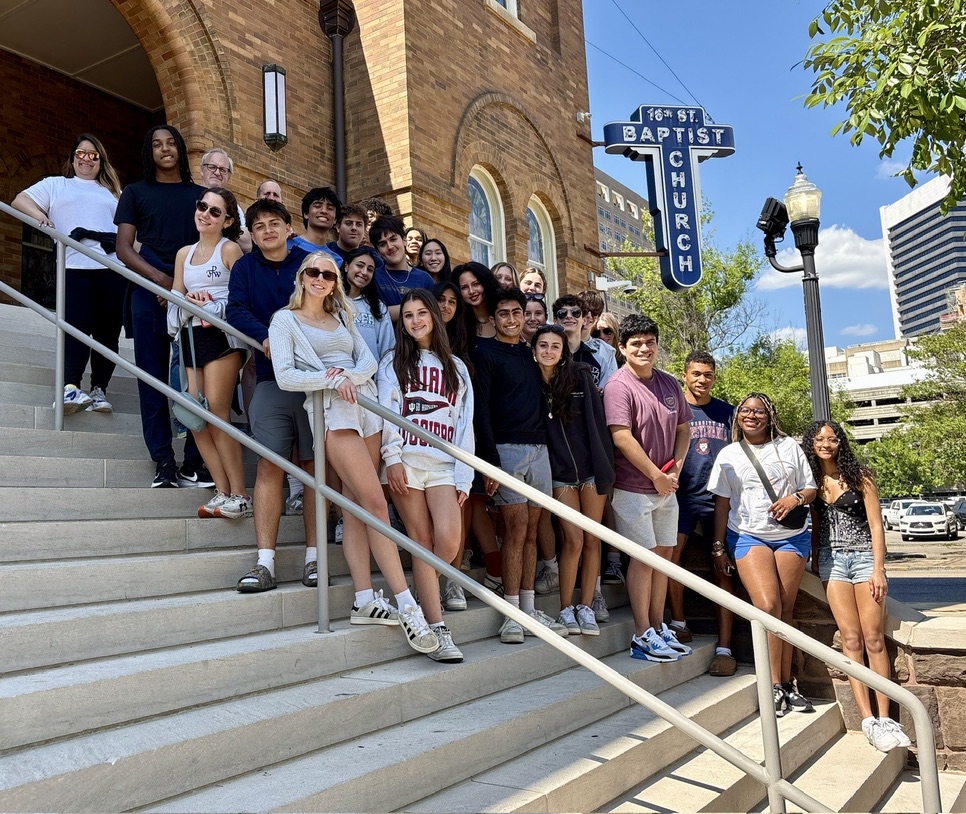
Although Parker students come from a big city, New York is more populated than Chicago. In order to keep students safe, chaperones Mr. Bruno and Mrs. Barr, “never let the students be by themselves, they always had to be with a buddy or two.…Chaperones were always with students,” Head of Upper School Joe Bruno said. “When students did have free time it wasn’t a long period, and they all had to have a partner. Everyone respected the boundaries. Everyone showed up on time. So I didn’t have an ounce of worry that we were in a big city.” When students had downtime, outside of doing school work, Mr. Bruno and Mrs. Barr took them to “New York City bagels, we did Central Park, we went to the Broadway museum, sightseeing, United Nations tour, [and] biking in Central Park,” Upper School history teacher Jeanne Barr said. Not only did Parker students experience the MUN conference, but they also got to experience New York City.
Delegates attend many different MUN conferences in Chicago, however, many students view the New York symposiums as “a unique opportunity…[because] it was hosted by a college rather than a high school,” Chawla said. It also “differed because there was people from all different countries…a lot of people had different opinions on things…it was interesting to see.” Hosting the symposium on a college campus also allowed for delegates to “experience the campus life as a NYU student. For example, during lunch breaks we would walk around the neighborhood and get bagels, while sitting in Washington Square Park,” Rosse said. Having the conference on a college campus rather than at a high school gave the delegates a taste of college life, while also giving them a taste of the UN.
With such a big conference and students from all over the world, prior to the conference, students expressed all different kinds of emotions. Some students expressed feeling “excited for the conference because of how many opportunities it had,” Rosse said. “I always tell myself before these conferences that I should just put myself out there because most of these kids I will likely never see again, so it doesn’t matter if I mess up. I didn’t want to go into the conference with regrets, so I just tried my best.” On the contrary, other students expressed feeling “nervous because I was in a pretty big committee, 55 people, and I didn’t know anyone in my committee so it was kind of scary to go up and speak in front of all of them,” Chawla said.
The MUN trip to New York was not only a way for students to explore what it would be like to be in the UN, but also a form of a cultural experience. For many years, Model UN has been a way to introduce students to global issues and teach them how to solve them with modern solutions and negotiation. The Model UN trip to New York allowed Parker students to explore the debate styles of those outside of Chicago and Illinois. Allowing students to explore different people and cultures helps to further broaden their view of the world. “ [MUN] is a way for them [students] to explore the world and the city as an extension of the classroom,” Bruno said. “There’s learning that goes on outside the classroom. I think Model UN is the perfect example of that. Students get to interact with other students from other schools, they get to showcase what they have learned, they get to put themselves out there, they get to speak in a public setting, they get to advocate for themselves, they get to do research, they get to have fun, I think it’s one of the greatest experiences our students can have.”