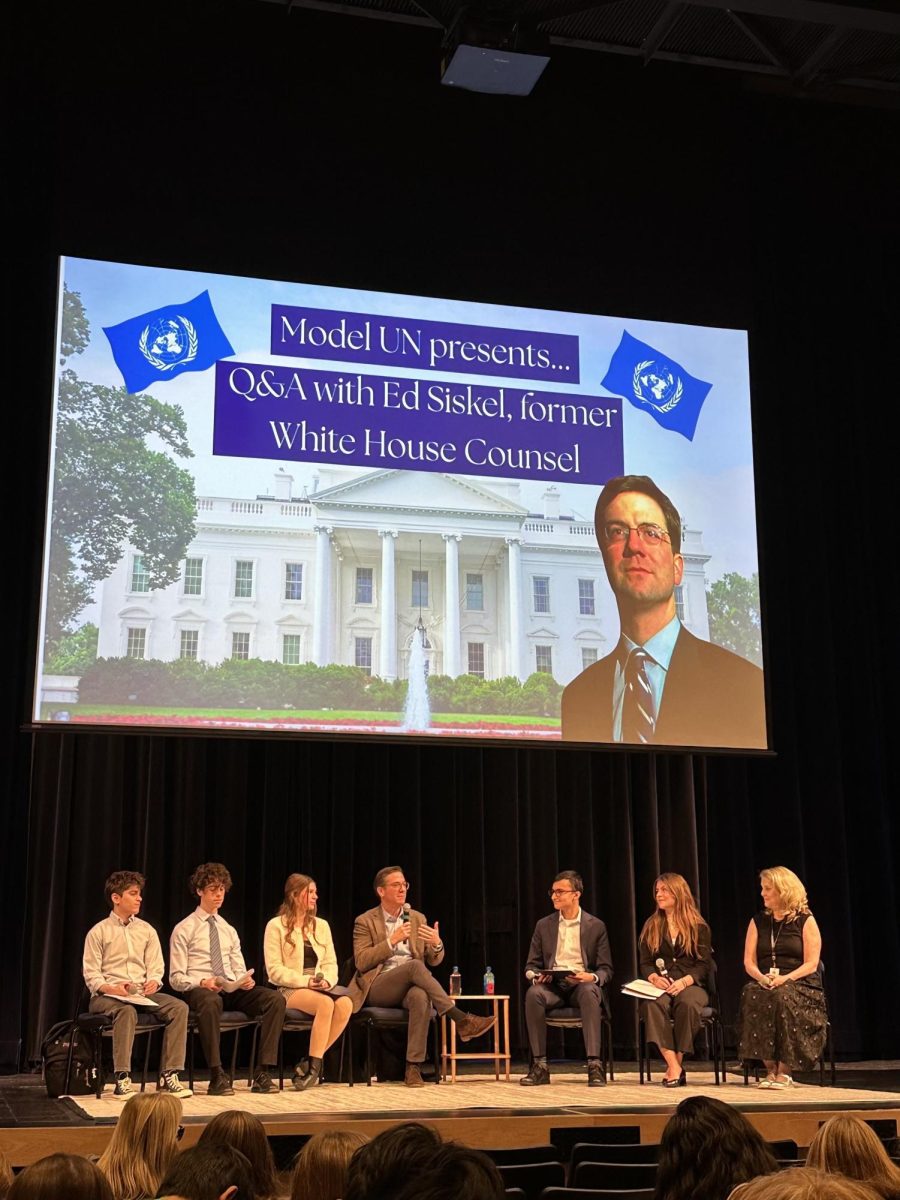
From Model United Nations to the White House Counsel’s Office to the Parker stage, Ed Siskel has long made his presence known and produced an enduring impact. On December 1, his words struck like a paintbrush and left a permanent mark on Parker’s community, emphasizing the importance of law and public service.
Before Siskel took the stage, an intense scene from “The West Wing” played for the audience. While television depictions of government are often dramatized, Siskel broke the tension with a joke, remarking that the scene shown was “exactly what it was like in the White House, absent the string quartet playing the ominous music behind me the whole time.”
He shifted into a detailed explanation of his work. In response to Weiss’s question, “What does the job of White House Counsel entail?” Siskel explained, “The job of White House Counsel is essentially to advise the president of the United States and the senior leadership in the White House on any legal issues that they face in executing the president’s policy agenda.” He described supervising “an entire team of about 40 lawyers,” divided into several groups: one handling judicial nominations, another identifying candidates for the federal bench, a third working on national security matters and a fourth managing ethics and compliance.
Siskel recounted a night in the Situation Room he said he would “never forget,” describing the moment when “Iran was launching an unbelievable barrage of missiles and drones at Israel.” The intensity of the situation illustrated the immense pressure carried by his role. But he also noted that the Situation Room often handled forward-looking discussions, such as meetings about artificial intelligence and how the U.S. should position itself in the global competition to lead in AI development. His reflections showed that the work extended beyond crisis response into long-term policy shaping.
Another highlight of Siskel’s career came during President Biden’s term, which he described as “record-breaking.” During that period, “a record for the most federal judges confirmed in a single presidential term” was set, amounting to 235 appointments. Yet the number itself was not the most notable part. “President Biden was very committed to having a federal judiciary that reflects the diversity of this country,” Siskel said, citing diversity not only in ethnicity and economic background but also in professional experience. “He appointed more public defenders, more labor advocates, more environmental lawyers to be on the federal bench than any of his predecessors, and I’m very proud of that.”
His analysis deepened in response to another question from Weiss: “What weaknesses do you see in the constitutional legislative processes that have led to the judicial branch having less independence?” Siskel began by discussing political gerrymandering, describing how states redraw congressional districts every 10 years and how Supreme Court decisions have made it “allowable to draw those boundaries in ways that favor one political party over another political party.” He noted that voters are increasingly “forced to take more and more extreme positions at the outer boundaries of political discourse,” causing the “middle ground” between Democrats and Republicans to become “more and more rare.” The result, Siskel said, is legislative “gridlock,” as polarized lawmakers struggle to compromise.
But what sorts of preparation went into his visit, and by whom? To understand that, it is necessary to look first at Siskel’s role as a member of the White House Counsel. The White House Counsel is a key team that works with the president. While its exact purpose within government has shifted over time, its importance and rank have remained high. Meeting with a former member would require immense planning and likely close connections. This raised many questions, particularly how the Parker Model United Nations team secured a Morning Ex meeting with a retired member.
“My family knows Mr. Siskel,” Dev Weiss said, a junior and Model UN captain. “He has an incredibly impressive career in public service, so I talked to him and learned he really loved doing Model UN in high school. I mentioned to him that I did Model UN, [and] we had the idea that he could come and talk about how Model UN shaped his eventual success.”
Ms. Barr added further context. “I’m so proud of what the kids have done. My role was more supporting them. But honestly, they didn’t really need a whole lot of coaches.” She emphasized the substantial effort the captains put into organizing the event. “I would [definitely] say it was a big team effort,” Weiss added.
In terms of intention, Ms. Barr said, “This [Morning Ex] is more speaking to a universal curiosity about what goes on in the West Wing, and what it’s really like to be that close to power.” She highlighted the types of questions that often surround such roles: “What’s it like to support the president? What’s it like to hold them accountable? What’s it like to keep them operating within the guidelines of their role?” Those questions framed the conversation Siskel came to address.
By the end of his visit, Siskel connected his reflections back to where his interest began: Model UN. He described how participation in Model UN sparked a desire to support the public, how engaging with public issues early demonstrated that young people can make a meaningful impact, and how anyone is capable of contributing to public service. Through this MX, Siskel demonstrated that change does not exist solely in the White House. It can begin in classrooms. With that in mind, one final question lingers: How might members of the Parker community contribute to public service in their own environments?