On a typical afternoon, while students were spending their time together in Parker PM, a dead rat was found in a common playspace meant for students. Many were shocked, some were afraid, and others were trying to problem-solve. “We were playing in the sandbox,” Charlie, a member of the class of 2039, said. “We were trying to make the rat die because it was spitting on us. So we dropped a shovel on it.”
Later, Charlie clarified that it was an adult who dropped the shovel, but regardless, she and her classmates were independently planning. “We were running in the sand, and someone dropped a leaf on it so that it would be dead,” Charlie said. Many expressed their conflicting feelings considering the rat was a living being, but at the same time, they believed that it didn’t have good intent, considering the spitting. According to the account of Charlie, this spitting was unprovoked.
Looking at why there suddenly seem to be more rats on the playground, many of the students noted a pattern. There was a noticeable increase in the amount of food left in the common playspace. However, the remnants of school lunches weren’t those that were left by the younger students but by those in older grades. “I was mad, and I was upset that this was happening, and so we took our garbage bags out, and we did a little clean up,” Junior Kindergarten teacher Stacey Buehler said.
Not only were these messes frustrating for Buehler, but they were also impacting other adults in the Parker Community. Cole Dunn and Robert Farmer, both Maintenance Technicians, have also noticed an increase in garbage left out. Farmer has been at Parker for 35 years, and Dunn,10, and the two have experienced changes in Parker throughout the years. “Maybe this year, because I go around through the school, like the back area, or someplace around where the seniors sit… I guess this year is worse than last year,” Farmer said. Dunn agreed.“Yeah, it was more than last year.”
Farmer explained, separate from his work, picking up after oneself is a core value of his. “If [a space] is clean,” he said, “and you’re leaving trash for someone else to pick up, that is wrong. People have got to be responsible for their own stuff.” Farmer added, “The housekeeping and the maintenance staff work hard to maintain the school, keeping the school building inside and out clean. When the seniors eat, socialize, or study in the area, they should want to have a clean area. When they are exiting the area, they should clean up behind themselves to help keep the area clean.”
The teachers, faculty, and young students alike were ready for change. Buehler, thinking about what she and her students could do, explained that this initiative wasn’t purely driven by her alone. She said, “The kids invested in, you know, taking care of our playground, so that we can play.”
The children, who range from four to five years old, have expressed their fears for the future of our planet regarding its health. For Masai, also in Buehler’s class, this evoked some deep emotions. “I feel bad for the Earth,” he said when asked about finding garbage in the playground. He continued, “It [garbage] gives the Earth more pollution.”
What many of the students noted, though, was that those who left trash behind weren’t from their grade. Rather, according to Masai, he “knew the big kids were littering.”
Others were more concerned with the health of the creatures rather than the garbage. If trash was left behind, “creatures would be able to get it,” CJ, a classmate of Masai and Charlie, said. He added that the garbage “has dirt on it,” which could harm the animals.
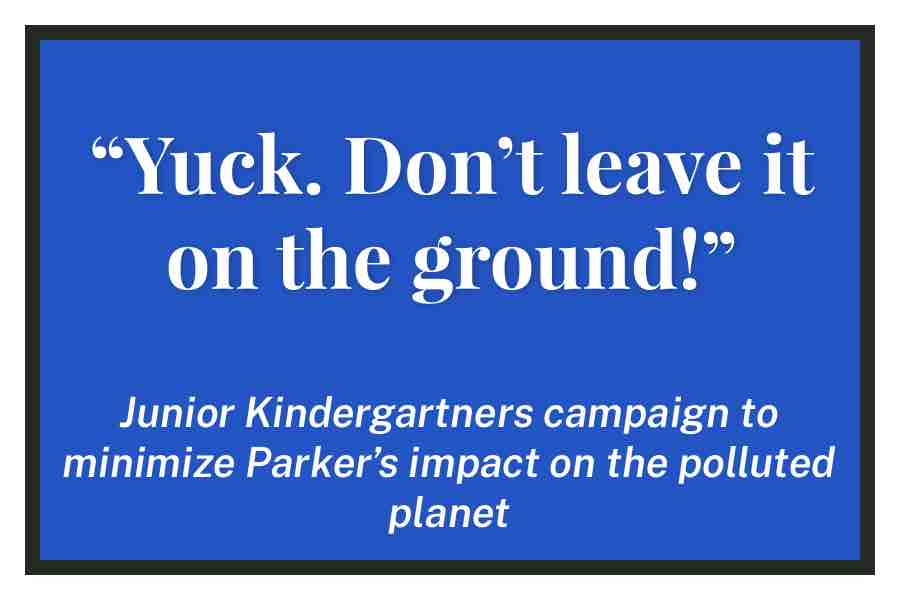
Ultimately, many people were craving change. Buehler, a children’s songwriter and singer, thought that this message could be demonstrated through song. She had lyrics that she felt could be slightly altered to fit this topic of yuckiness. In sharing the lyrics, she sang, “Yuck, don’t put it in your mouth. Yuck. Don’t take it off the ground, yuck. Don’t grind it in your teeth. Yuck. That’s the original. And so we were learning that, and then I said, ‘Why don’t we come up with a song that ties in things that are on the playground?’”
This led to another project for the students, which was visually campaigning for change within the Parker community. They had energy and were ready to use it. “So what we ended up doing is that we made some signs,” Buehler said. “The kids got excited, you know. What should the sign say? This was all very child-generated.”
The kids, accompanied by Buehler and her guitar, presented their signs during a Morning Exercise for the younger members of the Parker Community. Each of them brought up on the stage a piece of trash that was found outside and had been hand-cleaned by that individual. Buehler has hopes of giving the same demonstration to the older members of the Parker Community as well.