On February 13, Temple Grandin began her MX with a bang: “We need people to think differently,” she said. As an inventor, animal activist, and autism advocate, Grandin came to Parker to address a growing epidemic of the United States’ single-minded ways.
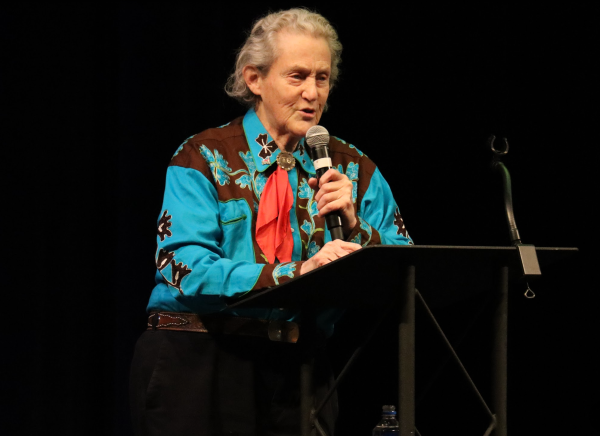
Grandin described how her work to transform views on autism and its perceived relation to intelligence serendipitously led her to discover different types of thinking. She explained what she describes as two main types of thinkers – object visualizers and spatial visualizers – and the critical importance of including both in education and later job planning. Grandin argued that systems are currently set up to support and favor verbal thinkers who process information through words to the detriment of those with the other two thinking styles. “She was very engaging with the audience, and although her talk was not during a MX time slot, it was worth taking the time to hear her explain that not everyone thinks the same,” sophomore Uriel Castaneda said.
According to Grandin, object visualizers think in detailed, photographic images. “You can look at a whole bunch of parts and see flowers. That’s visual thinking. That person is going to be super, super, super good at inventing mechanical equipment.” Spatial visualizers think in abstract patterns and tend to be strong at math and physics.
As an example of the importance of visual thinking, Grandin provided her perspective on the 2011 Fukushima nuclear accident in Japan. “Mathematicians designed a nuclear power plant but maybe didn’t consider the safety systems. It has an electrical cooling pump in the basement, and if that stops running, very bad things happen. They failed to protect it with waterproof doors, so when the tsunami came in, the basement flooded, the pump shut down, and then the reactor burned down. With simple waterproof doors, it would not have happened. Okay? Verbal thinkers tend to overgeneralize but object visualizers tend say ‘here’s the specific thing we can do.’”
Throughout her presentation, Grandin talked about her personal story and how a childhood full of discrimination based on her autism shaped her outlook and career journey. As a young child growing up in Boston, Grandin quickly learned that she viewed the world in a different way from most of her peers. “Everything I think about is a picture. I thought everybody thought exactly the same way that I did,” she said. “Then, I found out when I was in the late 30s that a lot of people thought more verbally.” Later diagnosed with autism, Grandin was initially told that she had brain damage and was forced to endure the confines of a neurotypical world. As a result, she was often harassed in school and was eventually forced to switch high schools after throwing a book at a bully.
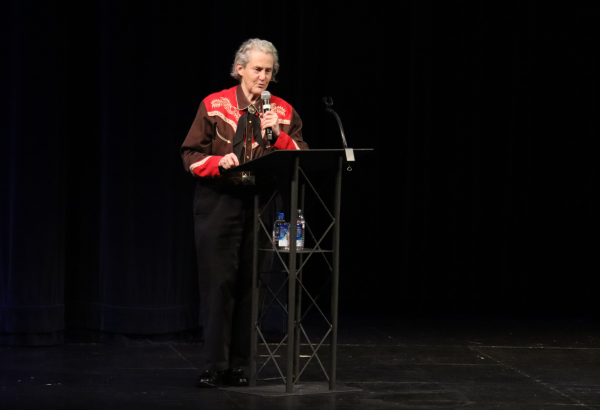
“I thought her experiences were super interesting,” senior David Mendoza said. “It was inspiring hearing how she managed to block out the hate she was receiving and turn it into something positive.”
While some classmates viewed Grandin in a negative light because of her unnormalized perspective, she used it as a superpower. Specifically, her ability to visualize in great quality allowed her to navigate in precise movements. “Autistic people are good at noticing detail,” Grandin said. “This visual thinking really helped me in my work lifestyle.” In fact, when she first settled into a career working at a farm, she was able to solve an ongoing issue about cow transportation because of her visualization. “[There was a reflection on the floor] most people were not noticing, and when I first started working on the issue, people could have thought it was crazy to get in the chute and see what cattle were seeing.”
For students with similar forms of visual thinking, Grandin suggests following her own approach of entering construction directly after school. “Heavy industrial construction is the fun stuff,” she said. “Most of the people I worked with [in construction] were either dyslexic or had autism. It provides challenge and structure.”
A large contributor to both autism advocacy and the animal rights crisis, Grandin has been listed as one of the “most influential people in the world” by the Time 100 list. She has also received the Meritorious Achievement Award from the World Organization for Animal Health, a Double Helix Medal, and several honorary degrees of varying levels from universities across the globe.