The yearbook is something most students don’t think about until it is distributed at the end of each school year. Every June, another edition of “The Parker Record” is added to a growing collection, flipped through by students, signed with sharpies on the field, and eventually stacked away for years to come. While many students are familiar with the final product, the process behind creating it often goes unnoticed. Faculty advisor of The Record and Upper School English teacher Mike Mahany said, “the process of producing the yearbook is a year-long process, and we depend not only on the Editors-in-Chief but also on dozens of section editors and page contributors.”
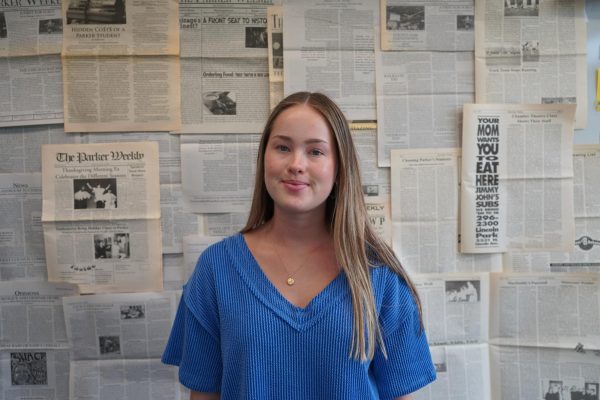
Behind the scenes, the yearbook is far more than just a book of photos. It is a carefully constructed record of the entire JK-12 community. Each year, four students work alongside Mahany and Assistant Principal Priyanka Rupani to lead the process. The 2026 yearbook EICs are junior Miriam Johnson, senior Eric Maset, senior Malea Caplan, and senior Louise Hall. The yearbook staff continues to work toward final deadlines as the school year progresses, coordinating across grade divisions to ensure all sections are completed. As Mahany noted, “the book needs to be completed by the beginning of May in order to have it ready to hand out on Class Day.”
“The process of making the yearbook is quite tedious. Pages are made by our staff, then edited by our Ed-Board, then edited by the EIC’s, and finally by our faculty advisors. Some pages even need to go through the administration team from the Upper, Middle, and Lower School,” Caplan said. Each page must go through multiple rounds of revision, meaning that even the smallest details are checked again and again by various members of the club. And even with all that work, the challenges don’t stop there. “The most tedious part is the website we use to make the yearbook because pictures lock and move without you doing anything, so publishers have to help us with that,” Hall said.
Accuracy is another major responsibility. Every name, every face, and every caption must be correct. “It’s also really hard making sure each photo has the people tagged, names are bolded, and the grammar is correct.” These are the details that help students see which photos they are in on class day. With so much work to do, the yearbook heads try to meet as a group one to two times a week. But as spring approaches, things start to get more serious, and the group has an in school field trip dedicated to a day of working on the yearbook. These long work sessions are necessary to bring everything together before final submission, something that would not traditionally be thought about. However, the experience is not without its rewards. “I think the most underrated part [about working on The Record] is the relationships I have built with our faculty advisors and my co-EICs,” Caplan said. “We spend so much time working together throughout the year, and over the past two years I have created lasting connections with students and teachers I probably would not have interacted with otherwise.”
And then, of course there is the theme. The theme is something that changes every year and the whole school looks forward to the big announcement. In previous years we’ve had the Parker playlist or the Parker playbook, etc. “At the beginning of each school year, we start thinking of a theme and hopefully have it by September. We try to get everything done by specific deadlines.” As for this year’s theme, Caplan leaves us with only one hint: “Wait for it. Sorry, not sorry!” and Mahany also provided the most obvious clue, noting that the theme included the word “Parker.” Do with that information as you will.