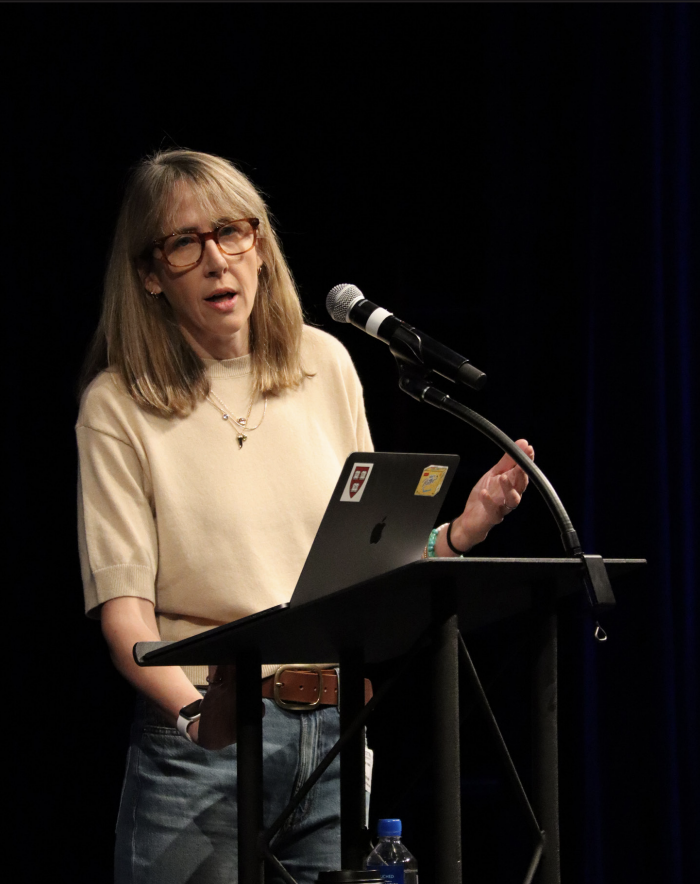
Before the auditorium sprang into applause, Sarah Haskins left Upper School career hopefuls with one counsel, “You always have something to fall back on: a Parker education.” Haskins is a writer, comedian, and, prosperously, a Parker grad. As part of the biannual Upper School Career Day, she served as keynote speaker, offering anecdotes for career life via Parker jargon, informing the student body on how they could afford “sick chains,” and relating her experience working in comedy to her time at the school.
Haskins attended Parker from JK through 12th grade. Throughout her time, her mother taught at the school off and on, and her father was a coach. After graduating in 1997, Haskins went on to attend Harvard College where she first encountered comedy through the Immediate Gratification Players, or IGP, improv troupe. After graduating Haskins returned to Chicago to perform comedy at the Second City and Improv Olympics before eventually moving to Los Angeles, California, LA, to work in film and television comedy. Her work on her Target Women series, the show Trophy Wife, and 2019’s Booksmart have garnered acclaim over the years.
“I was kind of baked in,” Haskins said, “Parker always felt like home.” Like the city that surrounds it, Haskins felt like Parker was a neighborhood school, filled with kids from all across Chicago engaging in the same community. “There’s something lovely about the continuity of a K-12 school,” Haskins said, “having community members you could look up to and think were cool, and then getting to turn around and be a mentor to the younger kids.” She’s grateful this experience still exists at Parker.
Another important facet of Haskin’s Parker experience was her eighth grade English class with Upper School English teacher Mike Mahany, who is still at the school after 36 years. Haskins gave a shout-out to Mahany during her speech, highlighting him as one of the most memorable and outstanding teachers she’s ever had. “It meant a lot,” Mahany said. “I didn’t know then that she would become who she’s become, but she was very talented and very funny.” Mahany also noted Haskins’ amazing stage presence in a Middle School production of Annie where Haskins played Ms. Hannigan, the over-the-top, comedic head of Annie’s orphanage. “She had an amazing ability to bring that humor forward,” Mahany said. “She had a confidence on stage that I had never had.”
While some aspects of Haskin’s Parker experience have stayed consistent, others, she noticed, have changed over the years. “I think there was a stereotype about Parker students when I was there, that it was very much an arts and humanities school,” Haskins said. “Being back, I think that’s changed a lot.” However, Haskins remarked on how Parker’s educational experience has always been rooted in creativity, something she still remembers fondly. When she was in fifth grade studying medieval times and the Renaissance, she wrote a paper comparing the Medici family to the Kennedys. “My fifth grade teacher, Mrs. Tilden was like, yeah, no, go run with that,” Haskins said. “There was always a creative element, or like letting yourself explore a little more and teachers willing to let you explore a little more.”
This element, she says, translates well into her career as a screenwriter. “I think being at Parker gives you confidence to be creative and try things and still feel supported,” Haskins said, noting how well Parker prepared her and other graduates to express themselves and their thoughts in writing. Haskins also recalled how her Parker experience influenced aspects of her BAFTA nominated film, “Booksmart,” along with memories of her and her co-writer Emily Halpern’s high school days. “We sort of desperately wanted to be more cool and partying in high school and just like, didn’t have that gene,” Haskins said, “and we just thought it would be funny if our characters had a moment where they were like, wait a second, we’ve put ourselves into a box.” Haskins found this to be very much a part of her Parker experience. “You sort of have that realization where it’s like, maybe I’ve been sort of keeping myself in a box and I’ve been judging them,” Haskins said, “as much as they probably haven’t been judging me in the same way at all.”
Even after high school, Haskins still felt the pressure of putting herself in a box and facing rejection. “Some of the setbacks [in my career] were because I had put myself in a box, like, ‘oh, this is what you have to do to be successful,’” Haskins said, “so I think some of it was like, ‘oh, I’m not doing the things I’m supposed to do.’” Yet, Haskins consistently moves on. “The privileged part of having this as a job is that from the rejection, I have to move on, like I have to get another job,” Haskins said. Looking back, she says she’s worked on way more projects than have ever been made, and she still dedicates herself to every one. “I do think if you’ve worked as hard as you can on something and really give it your all,” Haskins said, “then I think it makes the process of accepting that it didn’t happen a little better, because you didn’t leave something on the field.”
In many ways, Haskins has been able to break out of the box and find her own path to success. While she came to Second City to find her way to Saturday Night Live, the path didn’t break that way for her, and she’s been able to accept this and move on. “I’m not very good at staying up really late, so that might be an A plus decision for me anyway,” Haskins said. After moving to LA, she’s been able to work on her craft and create a unique comedic style represented in her over 19 years of work.
Haskins’ work tends to challenge conventional gender stereotypes, particularly surrounding women. This focus on the box that surrounds women societally has been a topic she hasn’t been afraid to challenge, starting very early in her life. “I was a girl who was not into dolls and pink and didn’t want to do that stuff,” Haskins said, “so I felt kind of hemmed in growing up by those definitions and expectations.” After experiencing these societal expectations of women as a child, Haksin’s drive to present women in a realistic and unconventional way has remained consistent, and has contributed to the impact of her writing. “Booksmart”, “Trophy Wife”, and “Target Women” have all been acclaimed for their feminist themes and challenge to female stereotypes.
Two days before her Career Day speech, Sarah Haskins sat down for a meeting to sell her next project, a drama. As she turned on the screen, a familiar face appeared. “I’m looking like, ‘you went to Parker,’” Haskins said, “and she started laughing because she knew that she was going to surprise me.” Through speaking at Career Day or working as a screenwriter, Haskins remains an active participant in the school’s community. “There’s the creative sort of spirit and excitement you get about making things [at Parker],” Haskins said. “I just was really grateful to be here.”