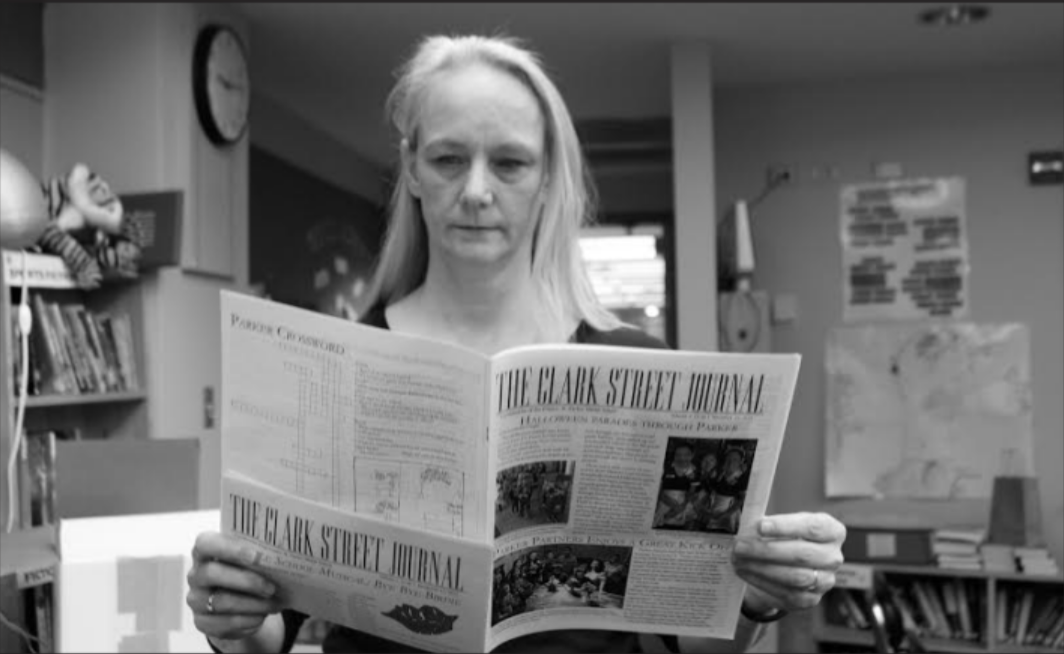
For nearly three decades, if you walked into the seventh-grade hallway at Francis W. Parker School, chances are you would hear laughter coming from Kate Tabor’s classroom before you even reached the door. Maybe students were debating a short story. Maybe someone was acting out a ridiculous character. Maybe Ms. Tabor herself was holding up an action figure to explain plot structure. Whatever was happening, one thing was certain: the room never felt static.
After 29 years at Parker, seventh-grade English teacher and team leader Kate Tabor is retiring, leaving behind generations of students, shelves of published writing anthologies, and a teaching legacy built around creativity, humor, and student voice.
“My journey at Parker began in January of 1998,” Tabor said. What started as a temporary position covering two American Literature classes quickly turned into something much larger. At the time, Tabor had one-year-old twins at home and intentionally avoided applying for a full-time teaching role. “I wasn’t exactly sure how I was going to teach 150 students,” she said. “And I wasn’t clear how I would ever sleep.”
But semester by semester, Parker kept calling her back. First two classes became three, then four. Soon after, an opening appeared in seventh grade English. “A miracle occurred,” Tabor said. “And I got to be a seventh-grade teacher.”
It was there that she found the age group that would define her career.
“Seventh graders still are open to doing all kinds of weird stuff,” Tabor said. “They’re funny, and they’re willing to try things.”
That openness shaped her classroom. Over the years, Tabor became known for designing projects that pushed students to think creatively while still taking their work seriously. She encouraged students to write comic stories, mysteries, fantasy pieces, and short fiction that often reflected the anxieties and humor of middle school life.
One of her proudest traditions became the publication of seventh-grade writing anthologies, something she continued for more than 15 years. “Students seeing their work in print changes the way they think of themselves as writers,” Tabor said. “If something’s going to be published, we’re going to take more time with it.”
She recalled one student who began a story with what he called “the most ridiculous character possible,” a cannibal hiding in library stacks. By the end of the drafting process, however, the student had become deeply attached to the character and transformed the piece into something heartfelt. “He kind of fell in love with his character,” Tabor said. “It ended up being a lovely story.”
For many students and colleagues, that ability to help young writers discover confidence in themselves became one of Tabor’s defining qualities.
Eric Rampson, library assistant and co-advisor of The Parker Weekly, said Tabor was “exactly the kind of English teacher I wish I had when I was in middle school.”
“She cares very much about the subject, but she’s also always looking to support the students in what they’re trying to do,” Rampson said. “There’s a definite traditional teacher there, but she also believes in progressive education and letting students follow their way.”
Rampson, who has worked alongside Tabor on student publications for the past six years, said her influence extends far beyond the classroom. He described her as someone unafraid to advocate for students and faculty when needed. “She has no problem being the squeaky wheel when she needs to be,” Rampson said. “She has a built-in justice meter.”
That advocacy also shaped her work with student journalism. During her time advising The Parker Weekly, Tabor helped eliminate prior administrative review of the paper before publication. Rampson said her leadership helped students gain greater editorial independence while maintaining journalistic standards.
“She’s less interested in controlling the content,” Rampson said, “and more interested in making sure the paper runs like a real paper should.” Students working alongside Tabor in publications noticed that same philosophy. Senior Lula Notz, an editor for The Parker Weekly, described Tabor as “the best advisor we could’ve asked for,” Notz said.
“She champions student journalism like no other,” Notz wrote. “She instills young writers with a strong sense of the power of their voices and the importance of their work.”
While Tabor’s career centered around writing, she said the relationships she built with students often mattered more than any curriculum itself. Some of her favorite moments came when students discovered confidence in abilities they did not initially believe they had.
She remembered taking a class to visit sculptor Jack Carney’s studio early in her teaching career. On the walk back to school, one student reflected on what it would mean to spend life doing work you truly loved. ‘“Oh, Mrs. Tabor,’ a student told me, ‘imagine doing what you love every day.’ and I thought, okay, you’ll do that someday,” Tabor said.
Over the years, Tabor witnessed major changes in education and student life. She adapted to shifting schedules, new technologies, and the rise of personal devices in the classroom. “There were a couple years where I felt like I needed to do something every 10 minutes to make everybody laugh,” she said.
Even with those changes, Tabor consistently prioritized independent reading and student choice. In recent years, she intentionally reduced the number of shared class novels to create more time for students to select books on their own. “I think it’s important for us to learn how to pick our own books,” she said.
Outside the classroom, Tabor’s impact stretched across Parker life. She worked with the faculty association, advised publications, contributed to yearbook production, and served as seventh-grade team leader for years. Ramsen said many people may not even realize how much she quietly handled behind the scenes. “Every time something happens, I’m like, ‘Wait, you’re doing that too?’” he said. “There’s so much she puts on her own plate.”
Now, as retirement approaches, Tabor is looking toward a different kind of writing life. She hopes to spend more time working on personal projects, including a young adult fantasy novel set in Chicago, historical mystery fiction, and nonfiction writing. “I’ve started trying to write them,” Tabor said. “By the time I get the head space to do it, it’s almost August, and then I start thinking about curriculum again.”
This time, however, August will look different.
Tabor said she is proudest not of one singular accomplishment, but of the collaborative work she built with students and colleagues over nearly three decades. “A good project,” she said, “is worth a thousand explanations.”
After 29 years in the classroom, thousands of stories read and written, and generations of Parker students shaped by her humor and guidance, Tabor says she feels ready for what comes next.
“I’ve just really loved being here,” she said. “Twenty-nine years feels like enough.”